In today’s world of increased digitalisation and interconnectivity the financial sector is at greater risk of information and communication technology (ICT) disruptions, including potentially catastrophic cyber threats. The Digital Operational Resilience Act (DORA) is a legislative framework aimed at enhancing the security of network and ICT systems of organisations operating in the financial sector. It creates a regulatory structure on digital operational resilience, whereby all entities can withstand, respond to and recover from all types of ICT related disruptions. These requirements are homogenous across the EU, with the core aim to prevent and mitigate cyber threats.
DORA seeks to bring uniform requirements for ICT risk management, incident reporting, digital operational resilience testing, ICT third-party risk management, and information-sharing arrangements. The regulation consolidates and upgrades ICT risk requirements to ensure a high level of digital operational resilience, enhancing the financial sector’s stability and consumer trust.
DORA also aims to reduce regulatory complexity, foster supervisory convergence, and increase legal certainty, especially for financial entities operating across borders. By harmonising ICT risk management practices, DORA helps financial entities minimise the impact and costs of ICT disruptions, ultimately preserving the integrity and efficiency of the financial market.
The 5 Key Areas of DORA
ICT Risk Management
- Establish and maintain a robust ICT governance framework.
- Regularly assess and mitigate ICT risks.
- Develop comprehensive ICT security policies.
- Provide regular ICT security training for employees.
- Implement ICT response and recovery plans.
- Develop and document backup policies and procedures.
- Detect anomalous activities promptly.
- Continuously improve based on post-incident reviews and technological development
ICT-Related Incident Reporting
- Develop an effective incident response plan.
- Classify and log all ICT-related incidents.
- Implement clear communication protocols for incident management.
- Perform post-incident analysis to determine root causes.
- Report major incidents to relevant authorities.
- Consider voluntary notification of significant cyber threats.
- Harmonise reporting content and templates with regulatory standards.
Digital Operational Resilience Testing
- Establish a comprehensive digital resilience testing program.
- Conduct regular risk assessments and modify testing frequency accordingly.
- Keep detailed records of resilience tests.
- Implement continuous improvement based on testing outcomes.
- Conduct advanced testing of critical ICT tools and systems.
- Ensure testers meet high suitability and reputability standards.
Management of ICT Third-Party Risk
- DORA also aims to reduce regulatory complexity, foster supervisory convergence, and increase legal certainty, especially for financial entities operating across borders. By harmonising ICT risk management practices, DORA helps financial entities minimise the impact and costs of ICT disruptions, ultimately preserving the integrity and efficiency of the financial market.
- Thoroughly assess and manage the security measures of third-party vendors.
- Ensure vendors comply with DORA requirements.
- Include specific security and compliance requirements in contracts.
- Regularly review and update contracts to reflect changing risks.
- Implement continuous monitoring and auditing of third-party vendros.
- Align processes with evolving regulatory requirements.
Information and Intelligence Sharing
- Partner with other financial insitutions to share information.
- Create protocols for sharing cyber threat intelligence.
- Consistently share threat intelligence focused on the financial sector.
- Coordinate efforts to identify and mitigate emerging threats.
- Credit Institutions
- Payment Institutions (including exempted ones)
- Account Information Service Providers
- Electronic Money Institutions (including exempted ones)
- Investment Firms
- Institutions for Occupational Retirement Provision
- Credit Rating Agencies
- Administrators of Critical Benchmarks
- Crowdfunding Service Providers
- Securitisation Repositories
- ICT Third-Party Service Providers
- Managers of Alternative Investment Funds
- Management Companies
- Data Reporting Service Providers
- Insurance and Reinsurance Undertakings
- Insurance and Reinsurance Intermediaries
- Crypto-Asset Service Providers
- Central Securities Depositories
- Central Counterparties
- Trading Venues
- Trade Repositories
Complyport specialises in security and resilience advisory services, offering customised solutions to help financial firms comply with DORA requirements.
At Complyport, we champion a resilience-centric approach, partnering with clients to continuously strengthen their ability to withstand and recover from increasingly disruptive events.
- Seasoned Team: Our team consists of cybersecurity professionals with extensive experience in compliance frameworks such as DORA and ISO standards.
- Proven Track Record: We have a strong history of helping organisations achieve and maintain compliance with regulatory requirements.
- Deep Regulatory Understanding: We support the seamless integration of DORA into existing frameworks, helping to optimise compliance efforts and reduce overall implementation costs.
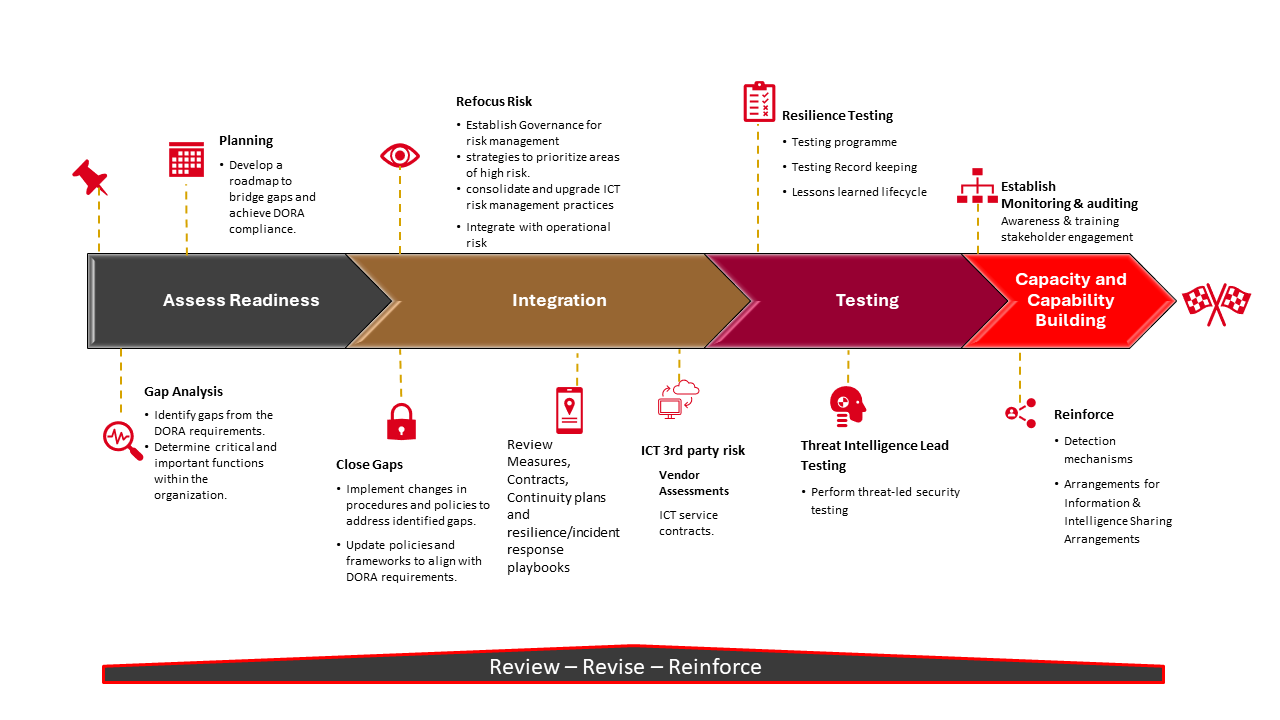
DORA Gap Analysis and Risk Assessment
- We assess your current security posture against DORA requirements, identifying any gaps or areas needing improvement and prepare a roadmap for closing the gaps.
- We evaluate your ICT risk management practices, incident response protocols, business continuity plans, and third-party risk management processes.
Development and Implementation of DORA Compliance Framework:
- We collaborate with you to develop a bespoke DORA compliance framework which outlines the policies, procedures, and technical controls needed to achieve and maintain compliance.
- We can build on any existing framework you have in place such as EBA Guidelines on ICT and security risk management (EBA/GL/2019/04), ISO 27001, etc.
Technical Support on DORA Requirements:
We can assist with implementing these technical controls and ensuring they meet DORA’s specifications.
- ICT risk management and governance
- Incident reporting and response
- Digital operational resilience testing
- Penetration testing
- Establish threat intelligence mechanisms
Third-Party Risk Management:
- DORA emphasizes managing risks associated with third-party service providers. We can help you assess the security posture of your vendors and ensure they adhere to DORA requirements.
- Review your contractual arrangements on the use of ICT services provided by ICT Third-Party Service Providers.
Ongoing Support and Maintenance:
Maintaining DORA compliance is an ongoing process. We can provide ongoing support to help you stay up to date with regulatory changes and ensure your compliance framework remains effective.
Our subject matter experts bring together a wealth of backgrounds, skills and expertise from the financial industry, legal sector and regulatory bodies.